4 min read
Admiration from a distance is not cultural appreciation
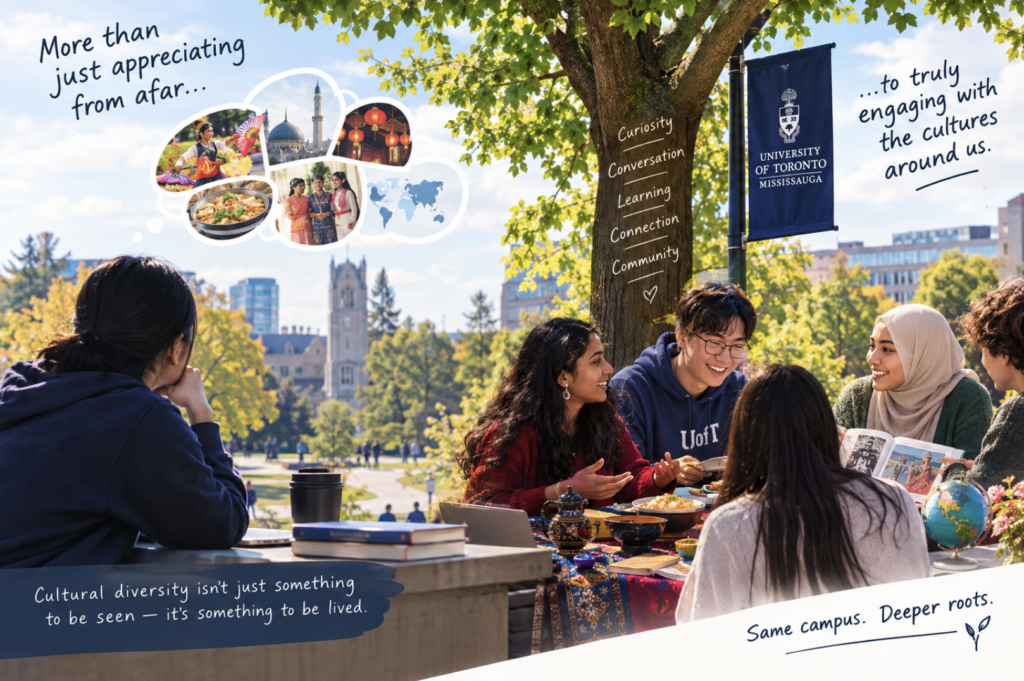
Have we over-relied on observing our multicultural environment rather than truly fostering it?
Rameen Hashmi October 18, 2026
As a University of Toronto Mississauga (UTM) student, chances are that you hold our campus’ multiculturalism close to your heart. After all, it is truly a gift and a privilege to be surrounded by such a richness of different cultures, nationalities, and heritages. According to a comprehensive survey of student demographics and identities by the University of Toronto’s (U of T) Student Equity Census Dashboard, the majority of students identify as East Asian, South Asian, and/or Middle Eastern, with UTM specifically harbouring a large South Asian population. And yet, while it seems the opportunities to learn about these cultures envelop us, perhaps we’ve failed to give the stories and people that make our campus so diverse even the slightest light.
Amidst our busy schedules, we may forget one of the core purposes of a higher education. Our studies should not only be to cultivate knowledge, but also to cultivate ways of knowing, critical thinking, and curiosity. You see, in our classes, we learn to not only summarize different works, but to connect them with other dialogues and contribute our own insights. In other words, we not only generally appreciate an abstract, but seek to learn from and engage with the work in a deeper way. It is a privilege to attend a university which is renowned for its research efforts and academic standing—and this can be invaluable to try and emulate in our everyday lives too.
But, when it comes to something as pertinent, consequential, and formative as culture, why do we stop at merely appreciating impressions from afar? This, in itself, begs the question: what does it mean to truly appreciate a culture, and therefore, our campus? And, taking this one step further, what might this look like in practice for students?
When reflecting on this personally, I found myself thinking back to my experiences in school. Having grown up in Mississauga, I was able to study in deeply multicultural schools that actively celebrated cultures and their exploration. Entire school projects would routinely be dedicated to immersing us into different cultures in course-relevant ways and school-wide festivities for cultural holidays would allow us to share our classmates’ joy.
My favourite initiative was my elementary school’s Multicultural Club, where students would research a country and host a cultural booth, often with food and games. I cherished this experience so much that I started a similar club in middle school, where another community passionate about celebrating cultural diversity gathered and grew as “global citizens” together.
I share these personal stories in hopes of highlighting the passion for cultural diversity that we all share, as evidenced by our current appreciation, for example. In addition, given the heavy reflections on the philosophy of our education, I hope to emphasize that pursuing cultural learning can be a fun experience; reflection and mere appreciation is not all that counts. And, lastly, what we can notice is the subtle distinction between now and then.
If you, too, experienced such multicultural education growing up, you may miss it “nostalgically”, at first glance. But, perhaps, part of what you also miss is the convenience at which it could be accessed. More specifically, many of these activities and educational initiatives were planned and built into our education. However, given our pathways are all so different, uniformly implementing built-in activities such as these are mostly infeasible. And, where many amazing learning initiatives are present, such as at the International Education Center, limited availability may prevent us from attending, despite our efforts. But, there is good news.
This is where, combined, our spirit of scholarship, curiosity, and shared love for celebrating diversity comes in. For example, when opportunities arise, such as cultural initiatives around campus, you can ask questions and perhaps later do some further reading about them on your own. You can welcome cultural conversations with your friends, try new cultural cuisines, or watch bite-sized videos about cultural histories and practices. And, if you’re looking for a new group activity with your friends, have you considered a cultural documentary viewing night? The opportunities are endless and the bottom line is that each of us can make cultural knowledge-seeking accessible again even if at first, we might not know where or how to start. Our campus is huge and our lives are busy, with many moving parts.
And yet, our university’s motto is velut arbor ævo: may it grow as a tree through the ages. In this tree, our love for cultural diversity may be as deeply rooted as our roots themselves. But, perhaps, as it has grown, we’ve stopped at simply enjoying its shade and beauty. Our efforts to explore and engage with the stories that surround us be improved on and perhaps, with every effort, will allow our tree to only grow stronger.